




- Home
- Artists
- Alex Katz
- Andy Warhol
- Angelo Accardi
- Arman
- Arnaud Nazare-Aga
- Banksy
- Bearbrick
- Bernard Aubertin
- Christo
- Damien Hirst
- Daniele Fortuna
- David Kracov
- David LaChapelle
- Dorit Levinstein
- Felipe Cardena
- Georges Braque
- Giosetta Fioroni
- Helmut Newton
- Henri Matisse
- iClim
- Invader
- Jacopo Di Cera
- James Rosenquist
- Jean-Michel Basquiat
- Jeff Koons
- Joan Miró
- Johnny Depp
- José Molina
- Kaws
- Keith Haring
- Kenny Scharf
- Liu Bolin
- Lucio Fontana
- Marc Chagall
- Marco Glaviano
- Marco Lodola
- Mark Kostabi
- Maxime Siau
- Miaz Brothers
- Mimmo Rotella
- Mr. Brainwash
- Mr. Savethewall
- Orticanoodles
- Obey
- Pablo Picasso
- Richard Orlinski
- Robert Indiana
- Roy Lichtenstein
- Romero Britto
- Salvador Dalì
- Stik
- Takashi Murakami
- Tomoko Nagao
- Tvboy
- Yayoi Kusama
- ...other artists
- Athos Faccincani
- Bill Byron
- Carlo Massimo Franchi
- Davide Nido
- Franco Costalonga
- Francesco Musante
- Giampaolo Talani
- Giovanna Fra
- Giuliano Grittini
- Giuseppe Chiari
- Hiroyuki Takahashi
- Hitomi Maehashi
- Lido Bettarini
- Manolo Valdés
- Manuela Manes
- Matteo Guarnaccia
- Maurizio Galimberti
- Mimmo Paladino
- Salvatore Emblema
- Sam Francis
- Ugo Nespolo
- Xiaogang Zhang
- Gift Shop
- META VR
- BLOG
- ABOUT
- BUSINESS B2B

- Artists
- Alex Katz
- Andy Warhol
- Angelo Accardi
- Arman
- Arnaud Nazare-Aga
- Banksy
- Bearbrick
- Bernard Aubertin
- Christo
- Damien Hirst
- Daniele Fortuna
- David Kracov
- David LaChapelle
- Dorit Levinstein
- Felipe Cardena
- Georges Braque
- Giosetta Fioroni
- Helmut Newton
- Henri Matisse
- iClim
- Invader
- Jacopo Di Cera
- James Rosenquist
- Jean-Michel Basquiat
- Jeff Koons
- Joan Miró
- Johnny Depp
- José Molina
- Kaws
- Keith Haring
- Kenny Scharf
- Liu Bolin
- Lucio Fontana
- Marc Chagall
- Marco Glaviano
- Marco Lodola
- Mark Kostabi
- Maxime Siau
- Miaz Brothers
- Mimmo Rotella
- Mr. Brainwash
- Mr. Savethewall
- Orticanoodles
- Obey
- Pablo Picasso
- Richard Orlinski
- Robert Indiana
- Roy Lichtenstein
- Romero Britto
- Salvador Dalì
- Stik
- Takashi Murakami
- Tomoko Nagao
- Tvboy
- Yayoi Kusama
- ...other artists
- Athos Faccincani
- Bill Byron
- Carlo Massimo Franchi
- Davide Nido
- Franco Costalonga
- Francesco Musante
- Giampaolo Talani
- Giovanna Fra
- Giuliano Grittini
- Giuseppe Chiari
- Hiroyuki Takahashi
- Hitomi Maehashi
- Lido Bettarini
- Manolo Valdés
- Manuela Manes
- Matteo Guarnaccia
- Maurizio Galimberti
- Mimmo Paladino
- Salvatore Emblema
- Sam Francis
- Ugo Nespolo
- Xiaogang Zhang
- Gift Shop
 Register
- Wishlist
- Contact Us
- META VR
- BLOG
- ABOUT
- BUSINESS B2B
 Register
 Wishlist
 Contact Us

Carrello
Thank you!
1
2

3
ORARI DI APERTURA
|MAPPA
lunedì
10.30 - 14 | 15 - 19
martedì
10.30 - 14 | 15 - 19
mercoledì
10.30 - 14 | 15 - 19
giovedì
10.30 - 14 | 15 - 19
venerdì
10.30 - 14 | 15 - 19
sabato
10.30 - 14 | 15 - 19
domenica
chiuso
- Home
- Artists
- Joan Miró
- Hand-signed works
- Le Scorpion Joufflu
icona
SECURE PAYMENT
Secure server, you can pay with Credit Card
icona
RETURN FREE OF CHARGE
You can return the works if you encounter problems
icona
FAST DELIVERY
3 working days for works in stock
icona
CUSTOMER SERVICE
Do you have any question? Ask us, we will help you
Le Scorpion Joufflu
Out of stock
| Artist: Joan Mirò | Width: 46 cm |
| Support: Paper | Height: 63.4 cm |
€8,476.19 VAT included
VAT included
Artworks with VAT included display a price calculated with VAT taxation, therefore the additional 5% tax is already added to the price of these products. For items that are not artworks, the taxation remains at 22% and is already included in the price.
VAT Margin
The products with VAT Margin apply the additional tax of 22% only on the margin, the difference between the price at which the product is purchased and the price at which the same product is resold.
THE ARTWORK
+ -
Joan Miró - Le scorpion joufflu
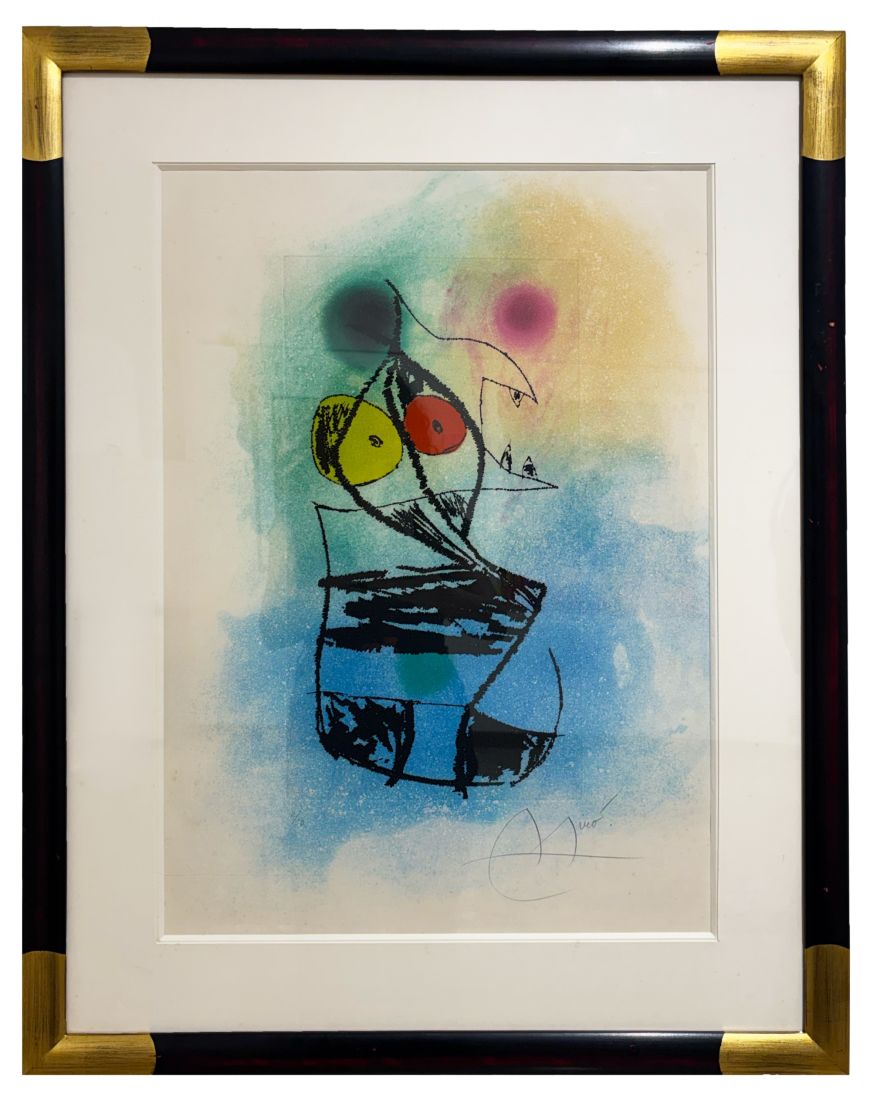
Le scorpion joufflu is a work by Joan Miró created in 1978, in a mature phase of his career, when the artist had already consolidated a personal language founded on the simplification of forms, the use of line and a strong chromatic freedom. The work fully reflects that research which had led André Breton to define Miró as "the most surrealist of us all".
The composition is dominated by a central figure constructed through black lines, essential forms and areas of intense color. Red, yellow and blue emerge powerfully against the more subdued background, creating an immediate contrast and conferring on the figure an almost symbolic character. As often happens in Miró's works, the subject is not described in a naturalistic way, but transformed into a presence suspended between recognizable image and abstract invention.
The title, Le scorpion joufflu, suggests the presence of a scorpion reinterpreted through the artist's visual vocabulary. The figure indeed assumes a fantastic appearance, far from a realistic representation of the animal. Miró reduces the form to a few essential elements and allows line, color and the balance between full and empty spaces to construct its identity.
The work also demonstrates the central role of graphic art in the artist's production. Since the 1920s Miró had experimented with lithographs, etchings and other engraving techniques, considered not as mere reproduction tools but as genuine means of research. In this engraving the line maintains a free and immediate quality, while aquatint allows for softer color areas and tonal variations that amplify the depth of the composition.
Created in the final years of his activity, Le scorpion joufflu testifies to the radicality of Miró's research, oriented towards increasingly essential forms independent from visible reality. The result is an image in which figurative and abstract elements coexist in balance, according to a poetics founded on imagination and the continuous transformation of forms.
Le scorpion joufflu is an etching and aquatint on paper from 1978. The work measures 44 x 23.5 cm, with sheet 63.4 x 46 cm, is signed in original by the artist and belongs to a limited edition of 30 copies. It is catalogued in the catalogue raisonné with the reference D.1011.
Joan Miró, Le scorpion joufflu: Prices and Quotations
If you are interested in the work by Joan Miró, Le scorpion joufflu and would like to know its price, click on "SHOW PRICE" to receive it shortly via email.
Do not hesitate to contact us for more information about the artist, the work and other works by Joan Miró for sale.
Discover the selection of graphic works and engravings available on our site and explore the production of one of the main protagonists of Surrealism and twentieth-century art.
ADDITIONAL INFORMATION
+ -
Joan Mirò - Le Scorpion Joufflu - Limited Edition of 50 Copies - 1978
| SKU | 26-500-0353 |
| Technique | Etching |
| Edition | Limited Edition of 50 Pieces |
| Support | Paper |
| Width | 46 cm |
| Height | 63.4 cm |
| Year | 1978 |
ARTIST: JOAN MIRó
+ -
Joan Miró: paintings and biography
Surrealist artist Joan Miró was a Spanish painter, ceramist and sculptor of the 20th century. The painter and critic André Breton described him as “the most Surrealist of us all”.
The first years of Joan Miró: life of a young talent
Joan Miró (1893-1983) was born from the marriage of a goldsmith and watchmaker, Miquel Miró Adzerias, to Dolores Ferrà of Oromi. Miró's first approach to drawing took place when he was only eight years old. Throughout his childhood and adolescence, he devoted himself to perfecting his artistic technique, in parallel with his business studies.
For the young Joan Miró, Barcelona was a springboard. Here he attended Galí Academy and Sant Lluc Artistic Circle, getting in touch with leading figures in the art world and discovering Fauvism.
Then he was later attracted by the community around Montparnasse. It was in Paris that Joan Miró met Picasso, one of the most famous painters and sculptors of the 20th century. The Dadaist circle of Tristan Tzara had also significant influence on Miró's art. Thanks to the contagious power of the poets and writers of Surrealism, Miró’s interest shifted to Abstract Art.
After his marriage with Pilar Juncosa in 1929, Joan Miró began his artistic experimentation, producing lithographs, etchings and sculptures, being introduced to painting on tar paper and glass, and to the Surrealist technique of grattage (the artist “scratched” freshly applied paint onto canvas or other support).
Among this period’s main works by Joan Miró, Harlequin's Carnival, The Farm and Peinture (Étoile bleue) are emblematic examples.
Joan Miró: The Farm
Painted between 1921 and 1922 in oil on canvas by Joan Miró, The Farm measures 123.8x141.3 cm.
The subject represented in the work by Joan Miró The Farm is one of the artist's childhood places. It is the family farm in Montroig del Camp, Catalonia. Signs of the Surrealist and Abstract influences are still absent. Instead, Miró's tendency to represent reality in a naïve style prevails.
Joan Miró: Harlequin's Carnival
Painted in oil on canvas between 1924 and 1925 by Joan Miró, Harlequin's Carnival measures 66x90.5 cm.
Despite preceding the publication of the Surrealist manifesto, in Harlequin's Carnival Miró scrupulously implemented its program, using psychic automatism, a technique that involved bodily efforts in order to stimulate fantastic and surreal visions. In Harlequin's Carnival, Joan Miró painted a large space with floating objects that narrate and invite us to take part in one of his visions.
Some references to the real world are recognizable: a black triangle representing the Eiffel Tower, a cat, a table, a ladder, a fish. But in Miró paintings, the real is transformed and reinvented, resulting in a new world that no longer responds - as in the earlier The Farm - to the visible world, but only to imagination.
The years of celebrity of Joan Miró: Surrealism and contempt for conventional painting
After having settled between Majorca and Montroig, Joan Miró increasingly embraced the current of André Breton, who described him as "the most surrealist of us all". In the writings of that time by Joan Miró, Surrealism and conventional painting are portrayed as two conflicting worlds.
In his first monograph, Joan Miró described his desire to "assassinate" conventional painting in order to create new means of expression. At the end of the 1940s, the artist began to work on loose ceramic pieces and bronze sculptures.
After a decade, Joan Miró had become an established artist: the prize for graphics at the Venice Biennale and the International Guggenheim Prize are among his greatest achievements. In 1972 the Fundació Joan Miró (Barcelona) was founded. Six years later, the artist created in the same city the sculpture Dona i ocell, now located in Joan Miró Park.
Works by Joan Miró such as Femme et oiseaux devant la lune, Dona en la nuit and Le Soleil rouge belong to this period.
Joan Miró: Femmes et oiseaux devant la lune
In the artwork by Joan Miró Femmes et oiseaux devant la lune, the theme of sexuality is linked to the one of night, described in a series of works Miró between 1942 and 1949. In Femmes et oiseaux devant la lune Miró enchants us with his childlike yet confident strokes.
In the work by Joan Miró Femmes et oiseaux, the simplification of forms is at its greatest. The figures appear as signs, floating between black patches and a few strong colours, in lively contrast with the background, whose ochre colour is highlighted by the rough canvas support.
The last years of Joan Miró
After the fall of Francoism, the artist was finally awarded in his homeland. A few examples are the honorary degree from the University of Barcelona and the Medalla d'Or from the Generalitat de Catalunya. Most of Joan Miró works date from this period: ceramics and paintings on glass engaged the artist during the 1980s.
In the last years of his life, Joan Miró style was influenced by his more radical ideas. The artist became interested in gaseous sculpture and four-dimensional painting. He died in Majorca at the age of 90.
Among the works from this phase of the career of Joan Miró, Constellations, Labyrinth and The Acid Melodies are emblematic examples.
Joan Miró: Constellations
The series by Joan Miró Constellations was completed in the last years of her life. It summarizes twenty years of the artist's life and research.
The series, consisting of 23 works, is a small-format cycle. Each work arose from an accident: the accidental cleaning of brushes on the support. In Constellations Miró described his controversial and visceral relationship with reality, conceived the surrounding world as a starting point for a journey to the stars.
André Breton described Miró Constellations as "superb paintings, from which a torrent of love and freedom flows". The large canvases, through plastic and sometimes aggressive colours, let Joan Miró's ideology emerge: art becomes a process of discovery.
Joan Miró paintings: for sale with prices and values on Deodato Arte
If you are interested in the artist, you can find Miró paintings for sale online on Deodato Arte website.
Do you want to know more about paintings by Joan Miró? Values and prices are available on our website. Miró paintings proposed by Contemporary Art Gallery Deodato Arte are carefully selected and provided with authentication certificate.
For any information about Miró paintings, please do not hesitate to contact us at [email protected].
SHIPMENT DETAILS
+ -
The artwork will be packed with rigid supports that will protect it from potential damage during transportation. It does not require a wooden box and delivery to EU countries takes 2-5 business days.
For deliveries outside the EU there may be a clearance delay at customs. Contact [email protected] to receive an estimate of possible customs delays.
The shipping cost is calculated before payment. The cost of packaging is included in the shipping cost.
For more information, please visit our Shipping Methods, Returns and Refunds page.
HOW TO BUY
+ -
We are happy that you decided to buy an artwork. We'll explain how to do it, but always remember that you can also buy via email ([email protected]), by phone (+39 02.80886294) or by physically coming to one of our galleries.
PRICE
If the price is visible in the product fiche you can click "ADD TO CART" and proceed autonomously choosing later how to pay and how you like shipping (or pick-up it in one of our store).
If the price is not visible, you must press the "SHOW PRICE" button, so you will receive an email with the price and a button, "DON'T LOOSE IT, BUY NOW": if the price is right for you click on this button and you will be sent back to the site to complete the purchase.
TAX
if you LIVE IN EU
If you live in Europe (CEE) the price we show you already includes taxes. The works are taxed either with VAT exposed (5%) or VAT with the margin, if you are a private person you do not change anything, if you are a company: in In the first case, you will recover the VAT, in the second, no. When you put the works in the cart you will be separated from the vat exposed.
If you DON'T LIVE IN EU and you want an EXTRA EU shipping
Many works (not all) have an exposed VAT of 5% included in the price, this vat will be spun off! Obviously you will pay the VAT to your destination country, if due. For example if you live in Switzerland you save 5% but you will have to pay 8.1% to your customs, if you live in Hong Kong you will save 5% and you will not have to pay anything to your customs (lucky you).
SHIPPING
Shipments are insured, check the product fiche for more information, or write to [email protected]. For works in stock the delivery time for Italy is three working days, before placing your order please contact us via email ([email protected]) or by phone (+39 02.80886294) to check availability.
PAYMENT
If you complete the purchase on the site you can use a credit card, or you can make a bank transfer. Payment in cash is accepted up to 5,000 euros physically in one of our stores. Payments in BitCoin or cryptocurrencies are NOT accepted.
OTHER ARTWORKS OF Joan Miró


